- Fondant was designed as a developer-experience and infrastructure project for Casper workflows.
- The project positions Alejandro beyond dApps and into tooling and ecosystem infrastructure.
Blockchain tooling
Fondant
A blockchain application suite and Ganache-like testing environment for the Casper blockchain, packaging CCTL functionality in a Docker-based UI to improve local development and testing workflows.
RoleBlockchain Developer
Timeline2023-2024
FocusBlockchain tooling
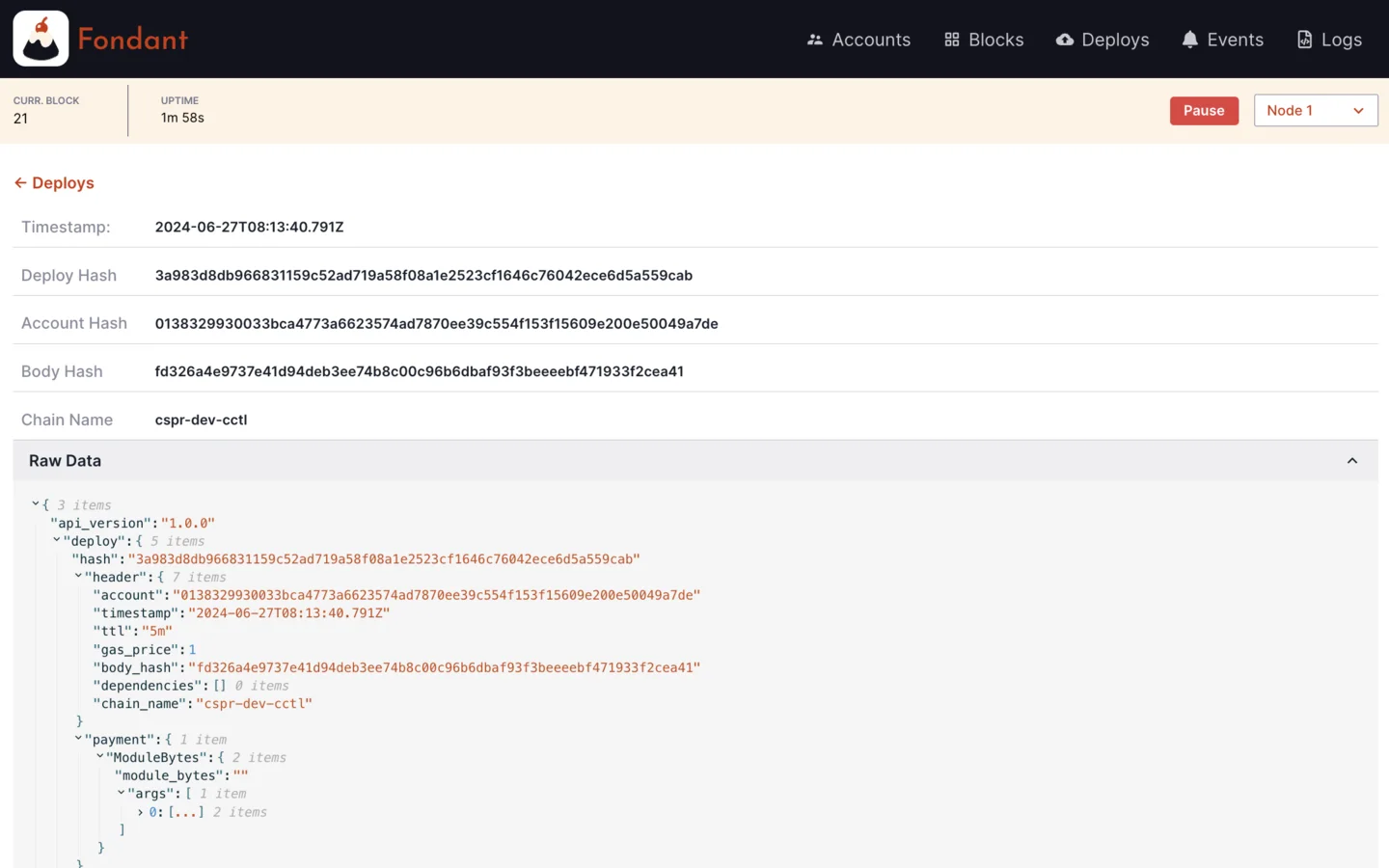
Deploy inspectionLocal node controlCCTL workflow
Overview
A Ganache-like local testing environment for Casper smart contract workflows.
A blockchain application suite and Ganache-like testing environment for the Casper blockchain, packaging CCTL functionality in a Docker-based UI to improve local development and testing workflows.
Problem, context, and constraints
Blockchain developers need fast, controllable local environments for testing smart contract behavior without relying only on public or shared environments.
Developer tooling is critical for shipping blockchain software quickly and safely.
Better local environments reduce friction, improve iteration speed, and lower testing costs.
- The environment needed to be repeatable for local development.
- It needed to simulate enough blockchain behavior to support useful testing without overbuilding.
- Developer convenience needed to be balanced against fidelity to real network behavior.
My role and contribution
Blockchain Developer
- Created a Ganache-like local testing environment for Casper workflows.
- Packaged CCTL functionality into Docker-based application flows.
- Built UI surfaces for accounts, blocks, deploys, events, and logs.
- Added backend proxy endpoints for local node RPC access.
- Improved local developer feedback loops for contract experimentation and testing.
Architecture and system details
A local development and test environment intended to simulate enough blockchain behavior to support iterative smart contract development and experimentation. It packages Casper CCTL functionality into Docker containers and exposes a UI plus RPC access patterns so developers can inspect state and interact with local nodes.
01Frontend
- TypeScript-heavy frontend
- Accounts, blocks, deploys, events, and logs views
02Backend
- Rust / blockchain tooling
- Backend endpoints
- Local node RPC proxies
03Infrastructure
- Docker
- Docker Compose
- CCTL
- Local blockchain environment tooling
04Workflow
- Contract experimentation
- Integration testing support
- Local Casper RPC workflows
Key technical decisions
- Context
- Developers need rapid iteration while testing smart contract behavior.
- Choice
- Create a local testing environment inspired by Ganache.
- Tradeoff
- Faster iteration may require choosing which real-network behaviors to simulate deeply and which to simplify.
- Context
- Blockchain tooling often creates friction for teams.
- Choice
- Optimize for practical workflows and repeatable testing.
- Tradeoff
- Developer convenience must be balanced against fidelity to real network behavior.
Security, scaling, and reliability
- Environment predictability matters more than distributed scale.
- Docker-based setup reduces cross-platform friction.
- UI inspection improves debugging speed.
- Fast local iteration was prioritized.
- Fidelity to real network behavior needed to be balanced against simplicity.
Testing strategy
- The environment was designed to support repeatable local contract and integration testing through Dockerized Casper workflows.
- Exact scenario coverage and test tooling are not documented in the public brief.
Result and proof
- Supported Casper ecosystem developers.
- Improved local development speed.
- Reduced dependence on slower shared environments.
Before
Slower or more cumbersome Casper testing workflows.
After
A more local, iterative developer experience.
Challenges, tradeoffs, and next steps
Hardest part: Reproducing enough blockchain behavior locally without overbuilding the environment.
Key learning: How important tooling is for developer adoption and productivity in blockchain ecosystems.
- Add stronger documentation.
- Add broader scenario coverage.
- Improve developer onboarding.
- Add clear example workflows.